

The "Vocational" vs. "Healthcare" Identity Crisis: Why Massage Therapy’s "Medical" Education is a Secondary Market Monopoly
For decades, massage therapy has been navigating an identity crisis. On one side, it is a relaxing, spa-oriented "pampering" service; on the other, it is a vital, evidence-based modality for pain management and rehabilitation.
Yet, despite growing recognition as allied healthcare, the primary education many massage therapists receive is, frankly, lacking in medically necessary, evidence-based treatment protocols.
Why is the foundational education so often low quality, and why does advanced, "medical" training feel like a secondary market exclusive?
The poor quality of primary massage therapy education and the absence of medically necessary treatment protocols in core curricula stem from a structural conflict between low entry barriers, historical lobbying, economic models of vocational training, and distinct scopes of practice.
Low Legislative Bars and the "500-Hour" Standard
The baseline for entry-level massage therapy education is dictated by state licensing boards.
- Minimal Curricular Space: Most U.S. states mandate a baseline of only 500 to 700 hours of training to acquire a license. For context, a physical therapist assistant requires roughly 2,000 hours, and a cosmetologist often requires 1,200 to 1,500 hours.
- Overcrowded Basics: Within those 500 hours, schools must squeeze in basic anatomy, physiology, pathology, business ethics, local laws, draping protocols, and student clinic requirements.
- No Room for Clinical Reasoning: This leaves almost zero instructional hours to teach complex clinical reasoning, differential assessment, or evidence-based orthopedic testing. Schools default to teaching uniform "recipes" or generic routines instead of customized patient intervention.
The Core Problem: Vocational vs. Healthcare Mindset
Massage education in the US is largely vocational, not academic. The primary goal of many schools is to prepare students to pass the Massage Board Licensing Examination (MBLEx) and get licensed quickly—often in 500-600 hours.
- Focus on "Recipes" Over Reasoning: Many schools teach rigid routines ("spa protocols") rather than clinical reasoning. Students learn a "Swedish massage routine" instead of how to assess sciatica, chronic whiplash, or rotator cuff issues.
- The "Fluff and Buff" Bias: Because massage is frequently associated with relaxation spas, curriculum developers often prioritize comfort over rehabilitation.
- Lack of Standardization: Education quality varies widely, and Accreditation by the Commission on Massage Therapy Accreditation (COMTA) is not universal.
- The Revenue Model: The fastest way for a school to graduate profitable, working students is to train them for franchise spas (e.g., Massage Envy), luxury resorts, or elite salons. These employers prioritize uniform "relaxation specialists" who can manage basic stress reduction and nervous system downregulation.
- Avoidance of Clinical Risk: Primary schools lean into relaxation because it presents fewer medical liability issues. They teach broad contraindications (when not to touch) rather than treatment protocols (how to actively rehabilitate acute or complex pathologies).
Why Schools Don't Teach Medical Protocols
Medically necessary treatment protocols—such as orthopedic massage, proper assessment, or oncology massage—are rarely taught in basic, entry-level programs.
- Liability and Liability: Many programs avoid specific, clinical protocols for fear of liability, fearing students might be interpreted as practicing physical therapy or medicine.
- Instructors Lacking Clinical Experience: Some massage instructors are excellent technicians but may not have experience working in medical environments, hospitals, or specialized clinics.
- Pathology is "Too Hard": Pathology, kinesiology, and physiology are complex subjects. In a "low-cost, high-speed" education model, these subjects are often watered down.
Lack of Academic and Research Infrastructure
Unlike other medical professions, primary massage therapy lacks a robust institutional educational framework.
- Instructor Qualifications: In many states, anyone can teach massage school as long as they have a few years of industry experience. Instructors rarely have backgrounds in adult education, clinical research, or advanced manual therapy science.
- Anti-Science Legacy: Historically, the profession relied heavily on anecdotal, pseudo-scientific, or unproven mechanisms (e.g., "flushing out toxins" or breaking up "fascial adhesions" by force) rather than evidence-based medicine. Mainstream medical curriculums require peer-reviewed scientific backing, which has historically lacked funding in the massage sector.
Why Medical Protocols Only Exist on the "Secondary Market"
This is the most frustrating aspect for new therapists: you graduate, look at your diploma, and realize you cannot actually treat the patients walking into your clinic. You are forced to pay for Continuing Education (CE) to get the skills you needed to start. Why is it like that?
- The "Profit" Model of CE: The massage education industry is bifurcated. Basic schools provide the "ticket" to work, while independent educators provide the "knowledge" to heal. These CE providers (e.g., post-graduate medical massage programs) can charge high fees for specialized skills.
- Specialization is Post-Graduate: Just as a nurse practitioner specializes after becoming an RN, advanced massage therapy is viewed as a specialty, not a foundational skill.
- The "School-of-Hard-Knocks" Mentality: Experienced therapists often argue that "clinical reasoning" cannot be taught in a 6-month program; it can only be learned through hands-on experience, making continuing education the natural next step.
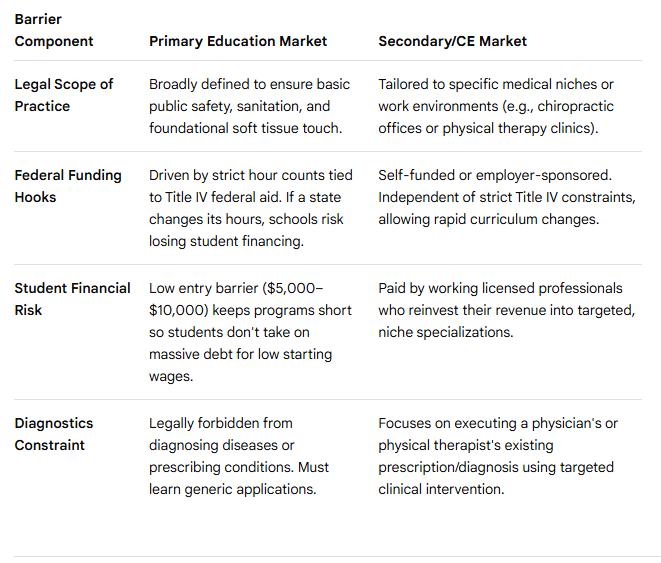
Advanced modalities like orthopedic assessment, neuromuscular therapy, manual lymphatic drainage, and oncology massage are relegated to post-licensure continuing education due to regulatory, liability, and structural constraints:
The Path Forward
To bridge this gap, the industry needs to push for:
- Higher Licensing Standards: Moving from 500 hours to 1000+ hours (like in New York).
- Clinical Integration: Integrating therapists into rehab clinics to learn proper documentation and assessment.
- Adoption of Evidence-Based Curriculum: Moving away from "energetic" or "traditional" beliefs and focusing on anatomy, physiology, and pathology.
Until primary massage education catches up, the onus of learning how to truly treat patients remains on the therapist, seeking out quality, evidence-based education in the secondary market.